Wednesday, 20 July 2016

The King of Scots and his Army

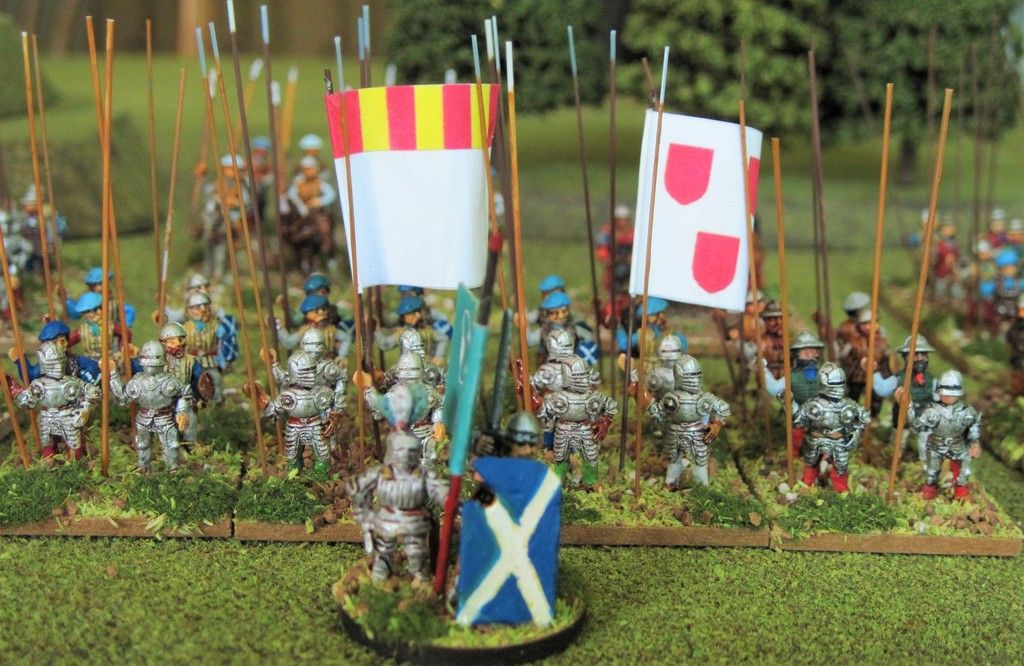
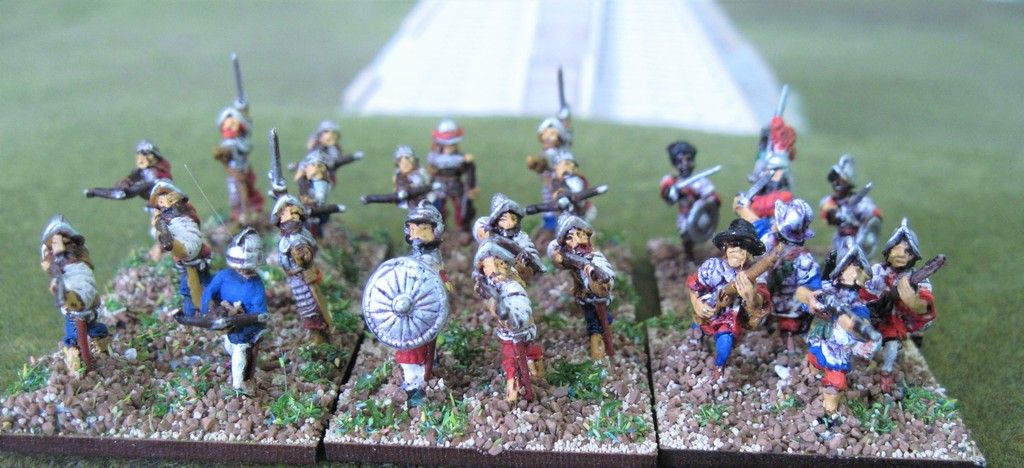
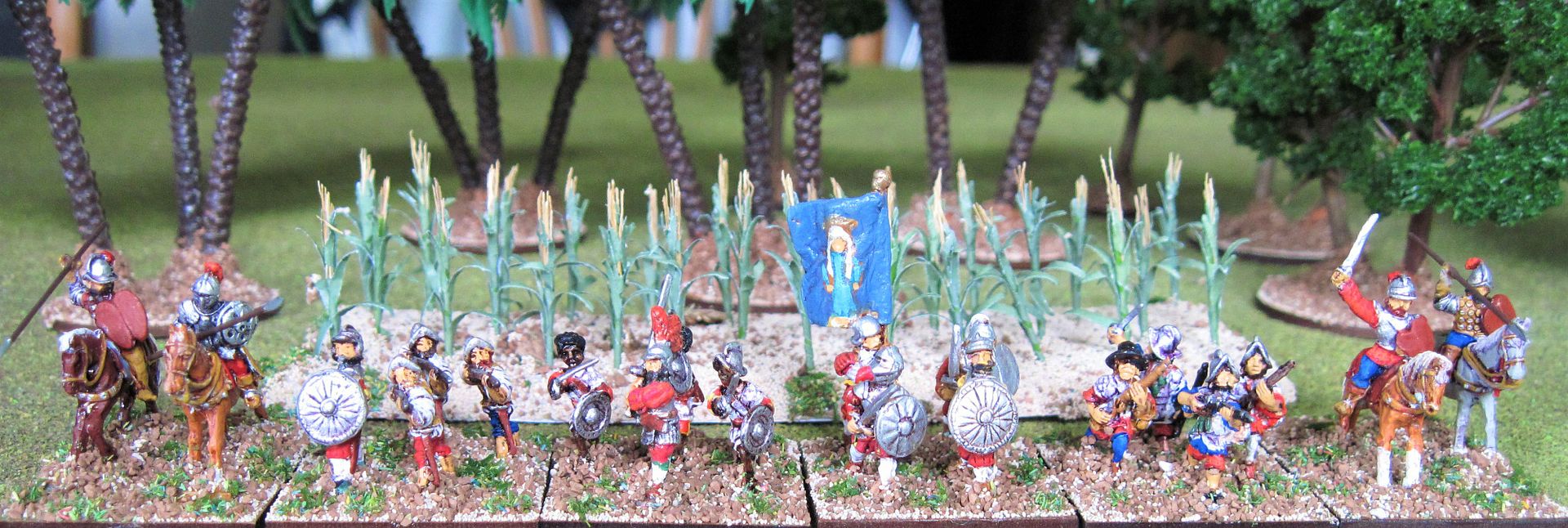
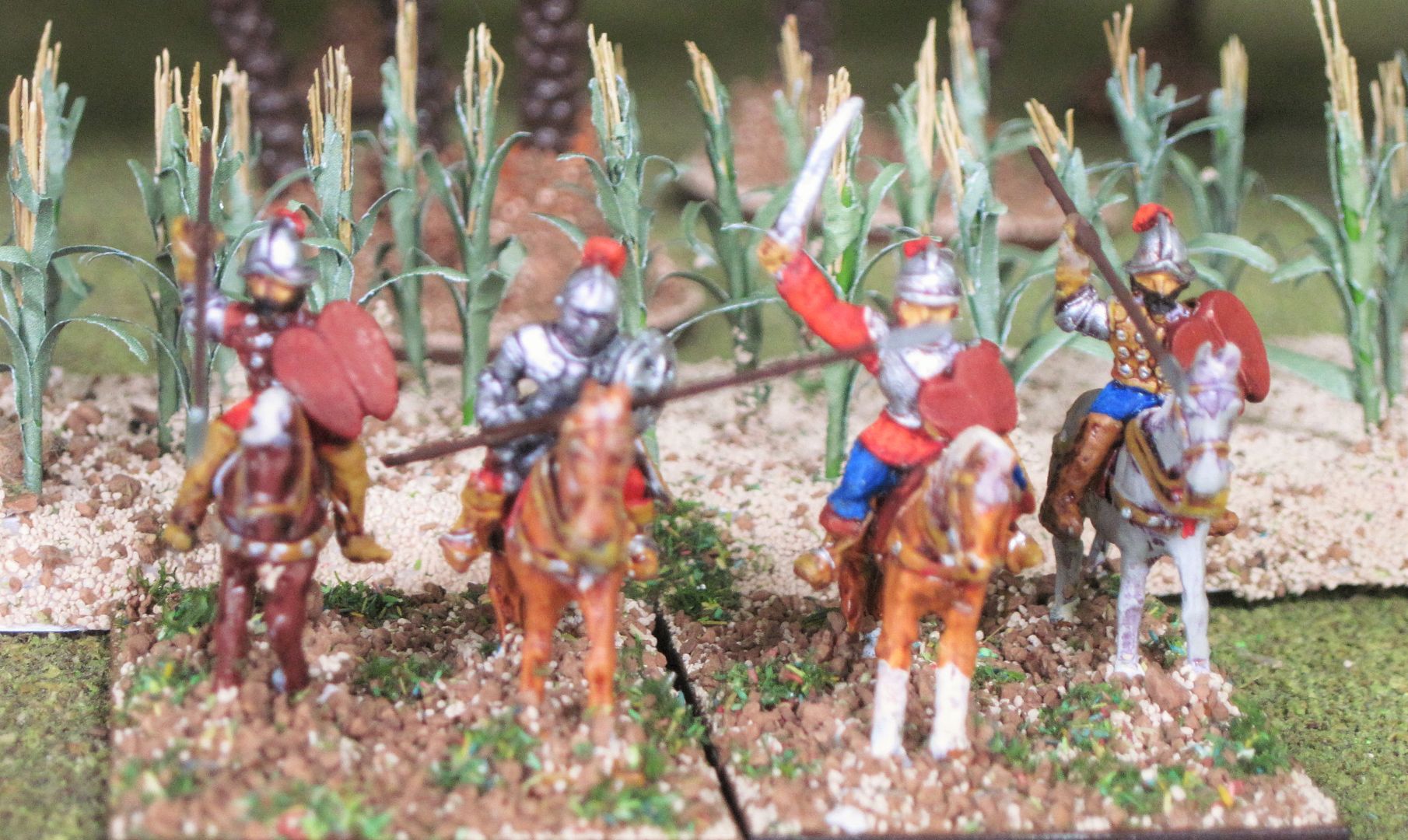
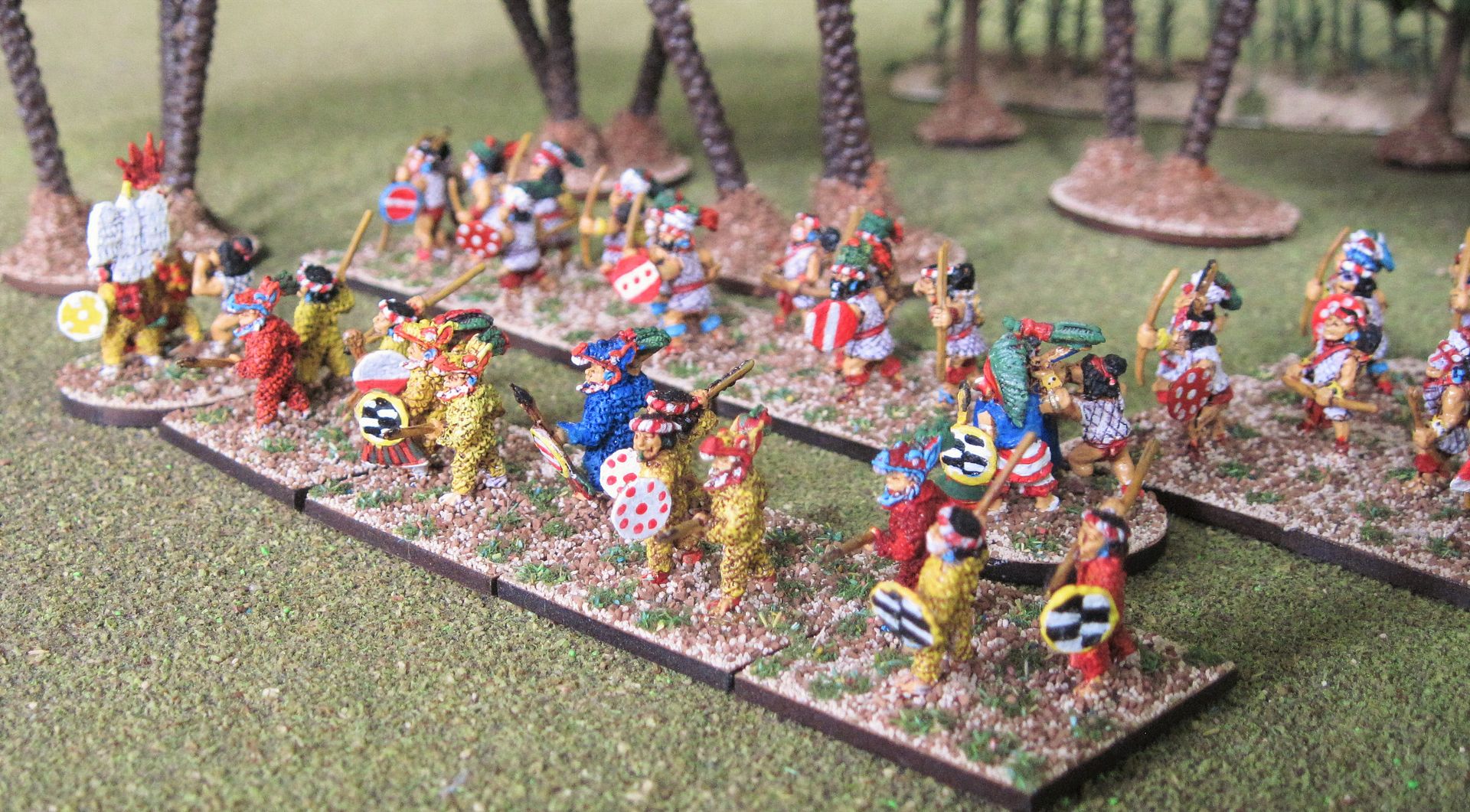
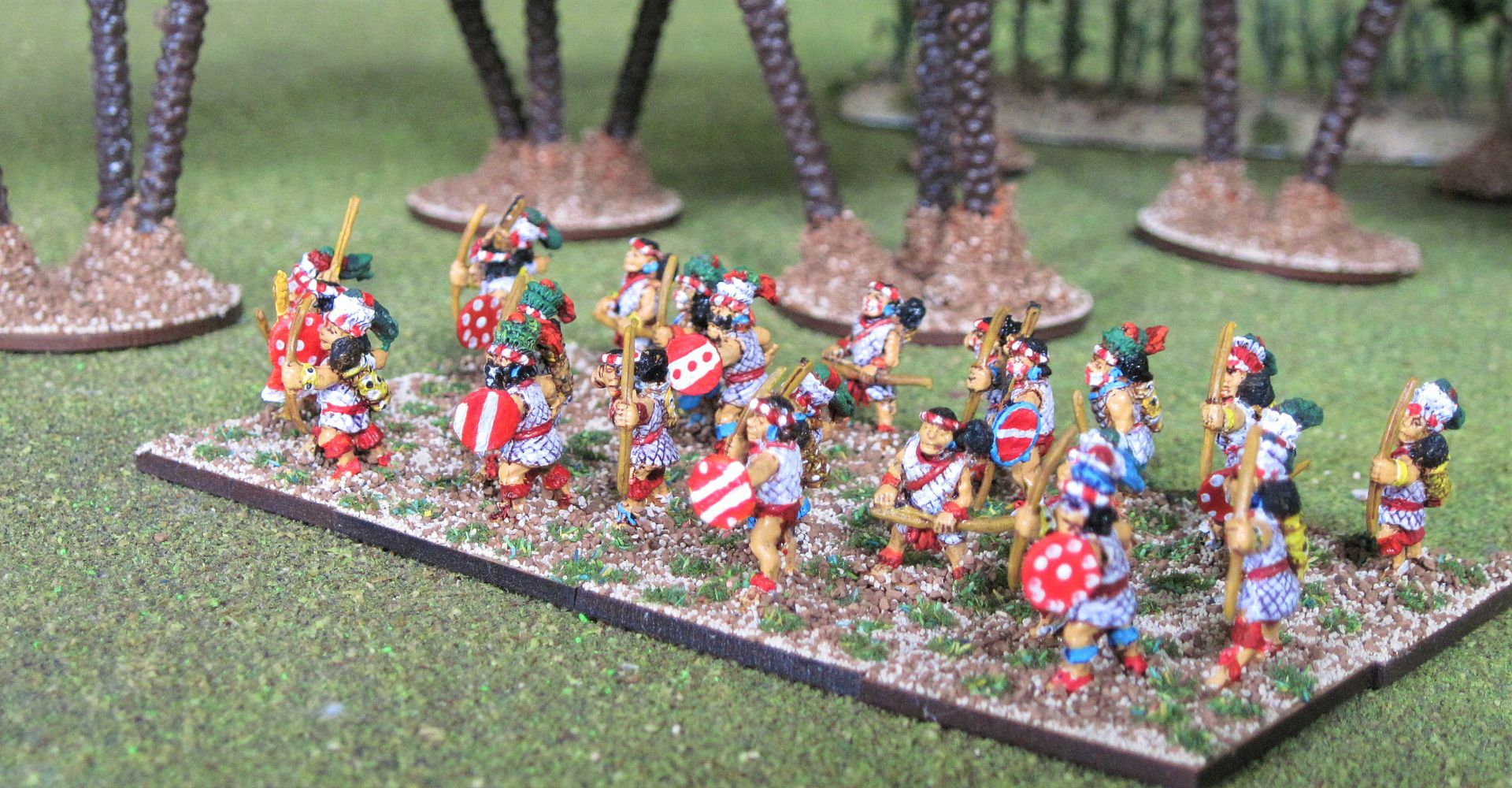
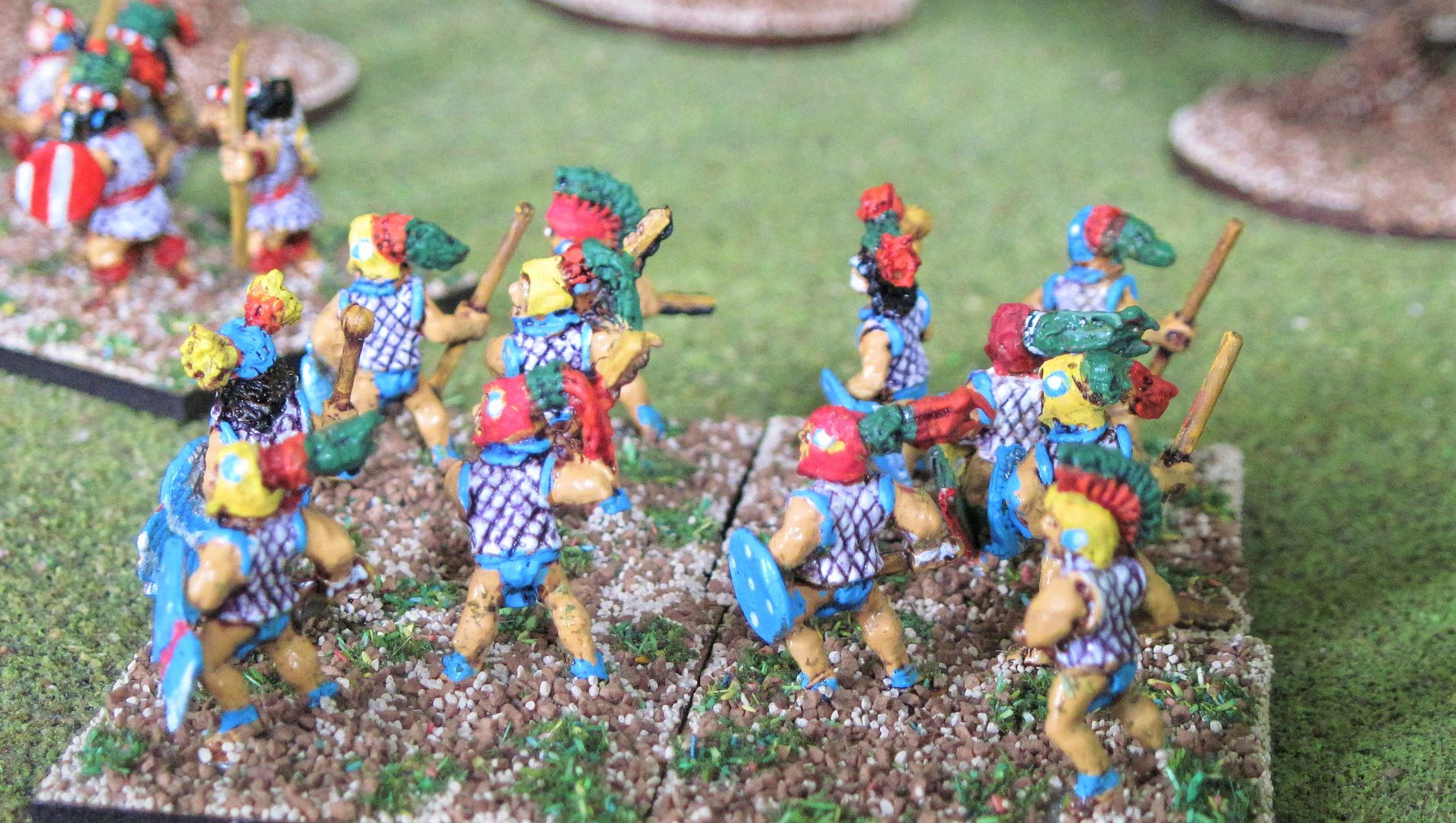
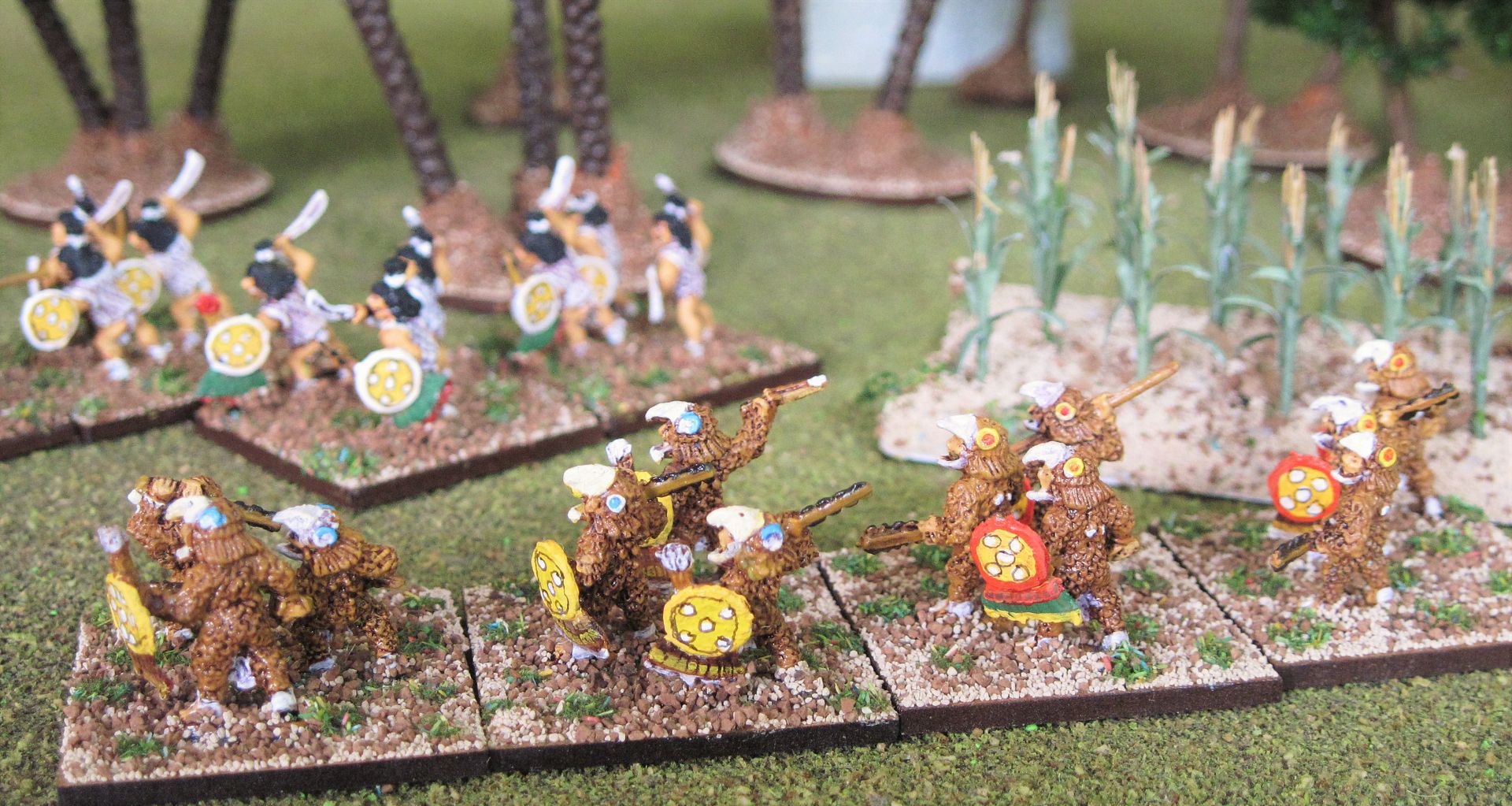
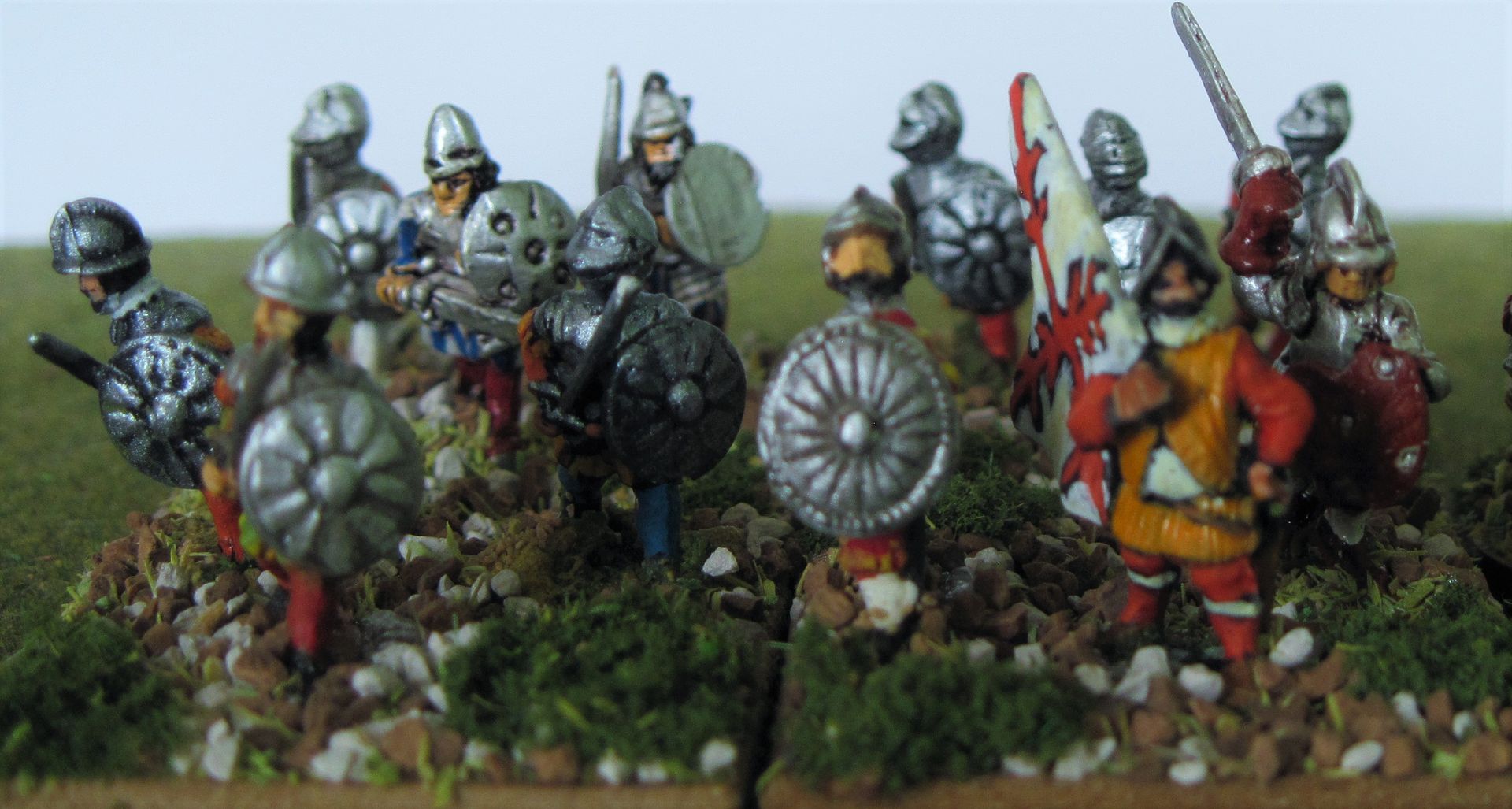
About twenty years ago at a show in the North East I bought these figures from Steve Shaw.  I painted up a couple of units and well…lost interest.  Steve sold his ranges to QRF who subsequently sold them to Bloody Day in the USA. 

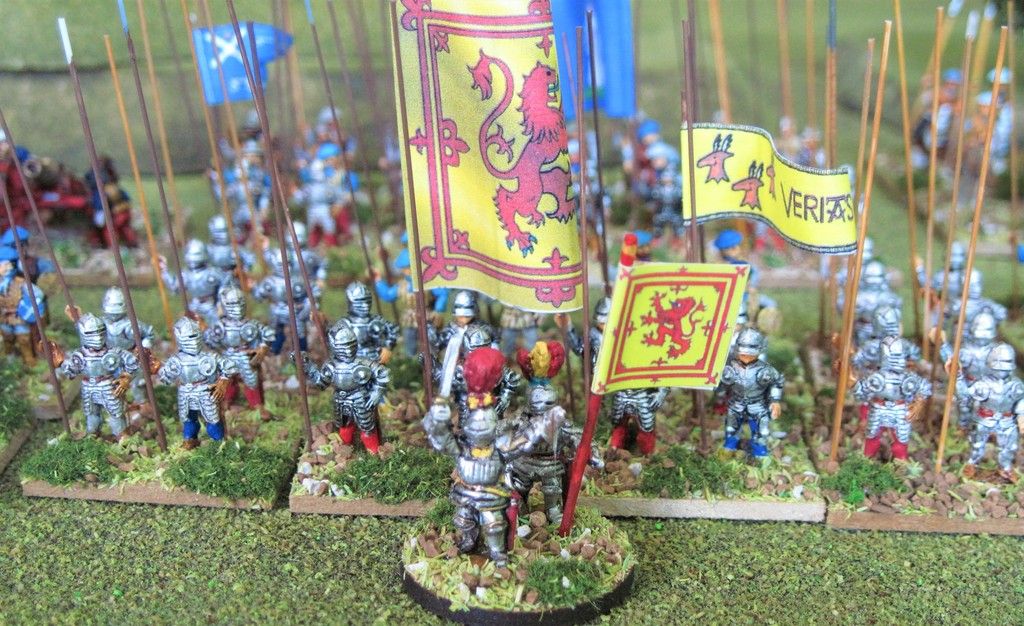
Then I came across the ‘Don’t Throw a 1’ blog you’ll find a link opposite.  Ray the proprietor had a couple or so of Flodden posts with some lovely looking flags for both sides.  Very kindly he makes them available as a free download.  That was the spur I needed to finish the King of Scots and his Army.  So better late than never and I hope you enjoy the results. 

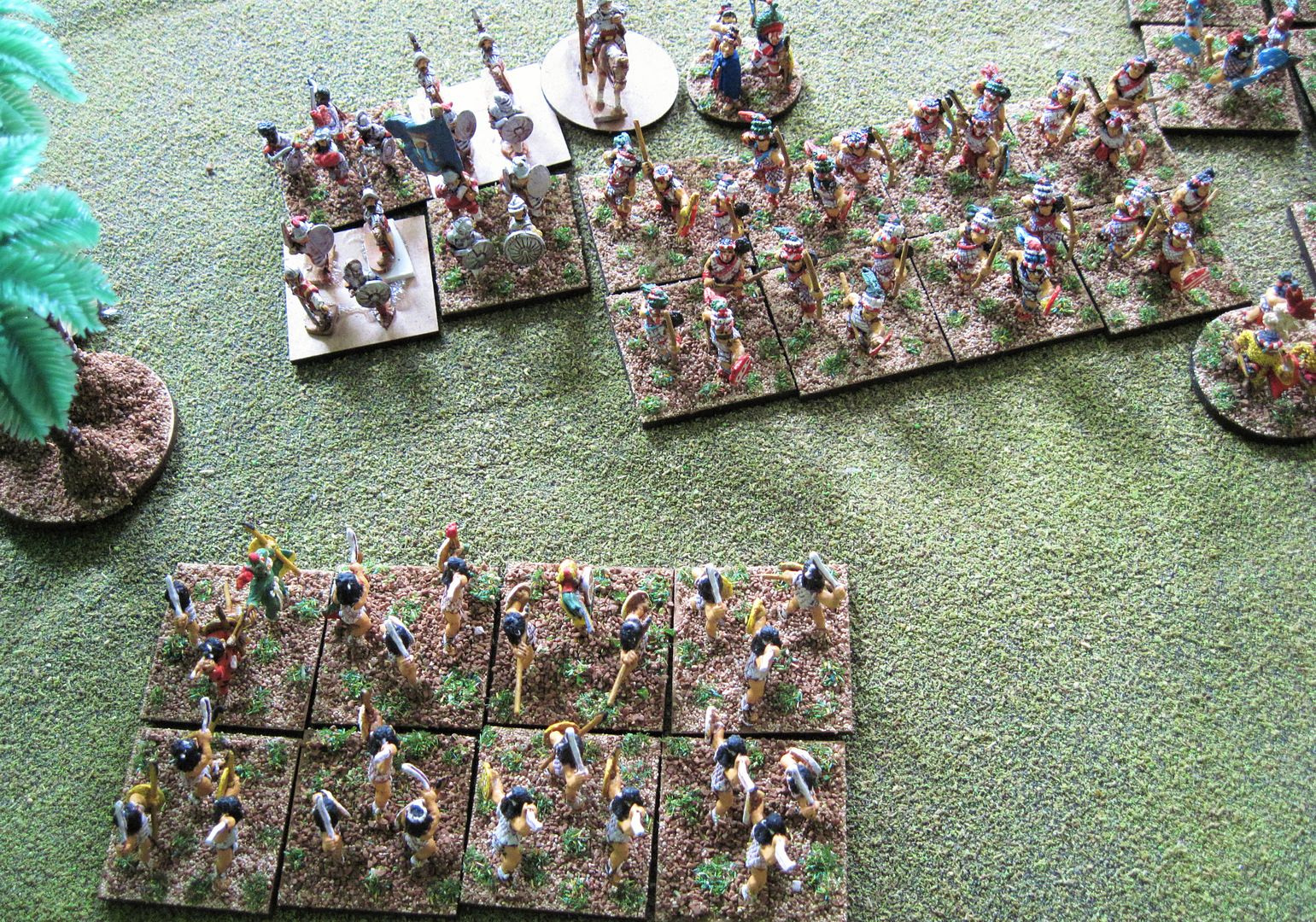
The Battle of the King of Scots seconded by the men of Edinburgh.


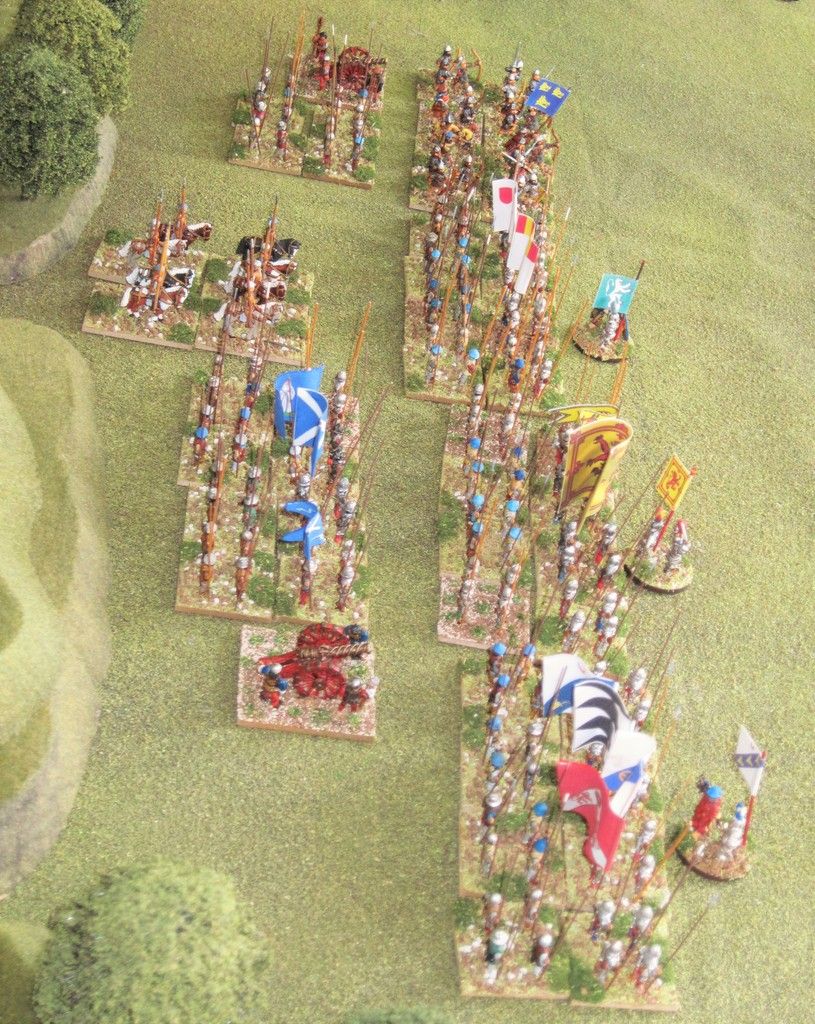
The whole army.


Nobles and more nobles.


For games with these lads I use Hell Broke Loose.

Monday, 18 July 2016

All Units Mixed, Big and Small

The mixed unit is an established gaming concept enabling us to reflect formations of troops with different abilities or equipment.  Sometimes it’s a unit with mixed missile and melee soldiers or perhaps the best equipped and ablest at the front and lesser souls in the rear.  It is a very useful device for gaming the Conquest.  Mexica, Tlaxcala and Spanish all fielded some type of mixed unit.
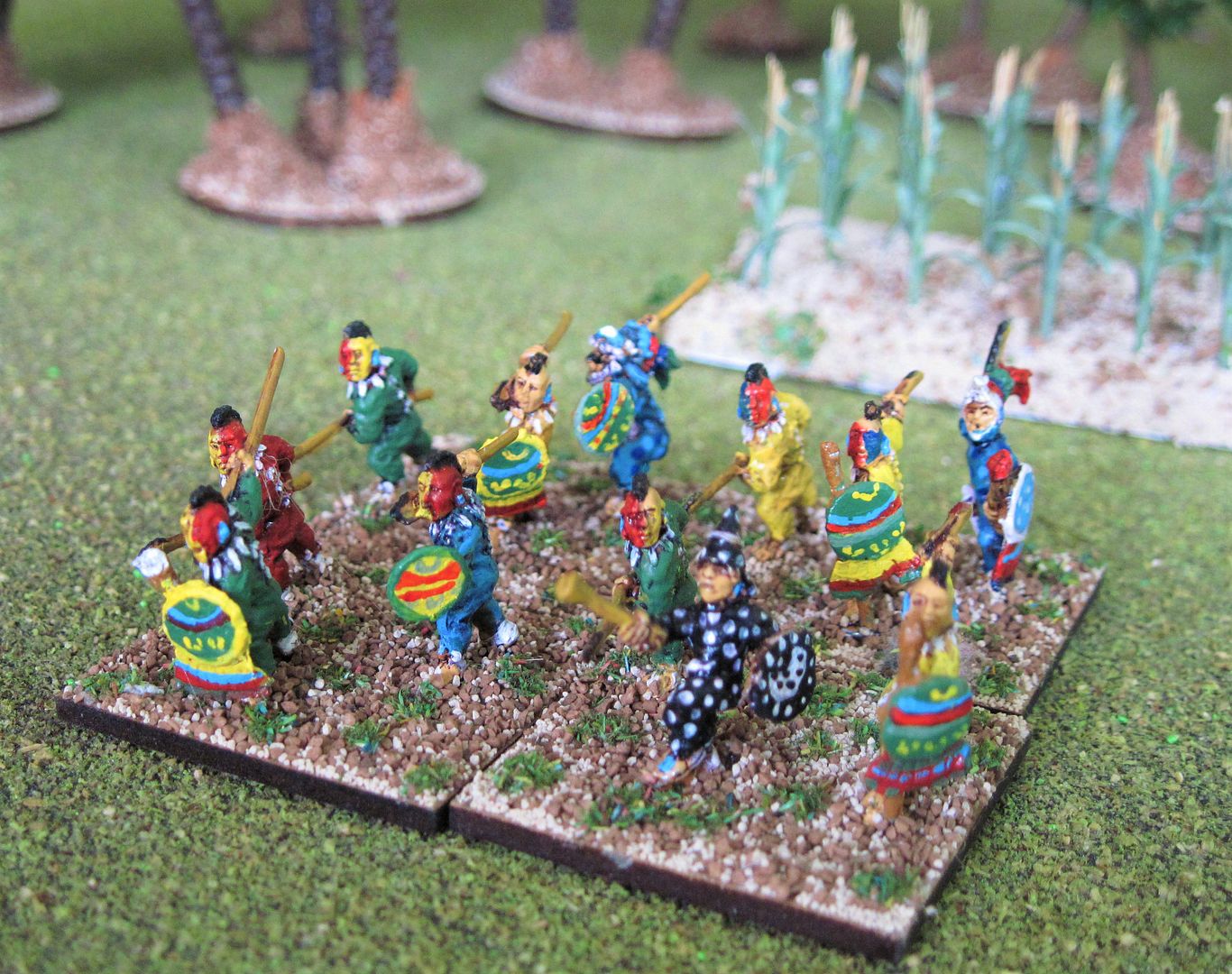
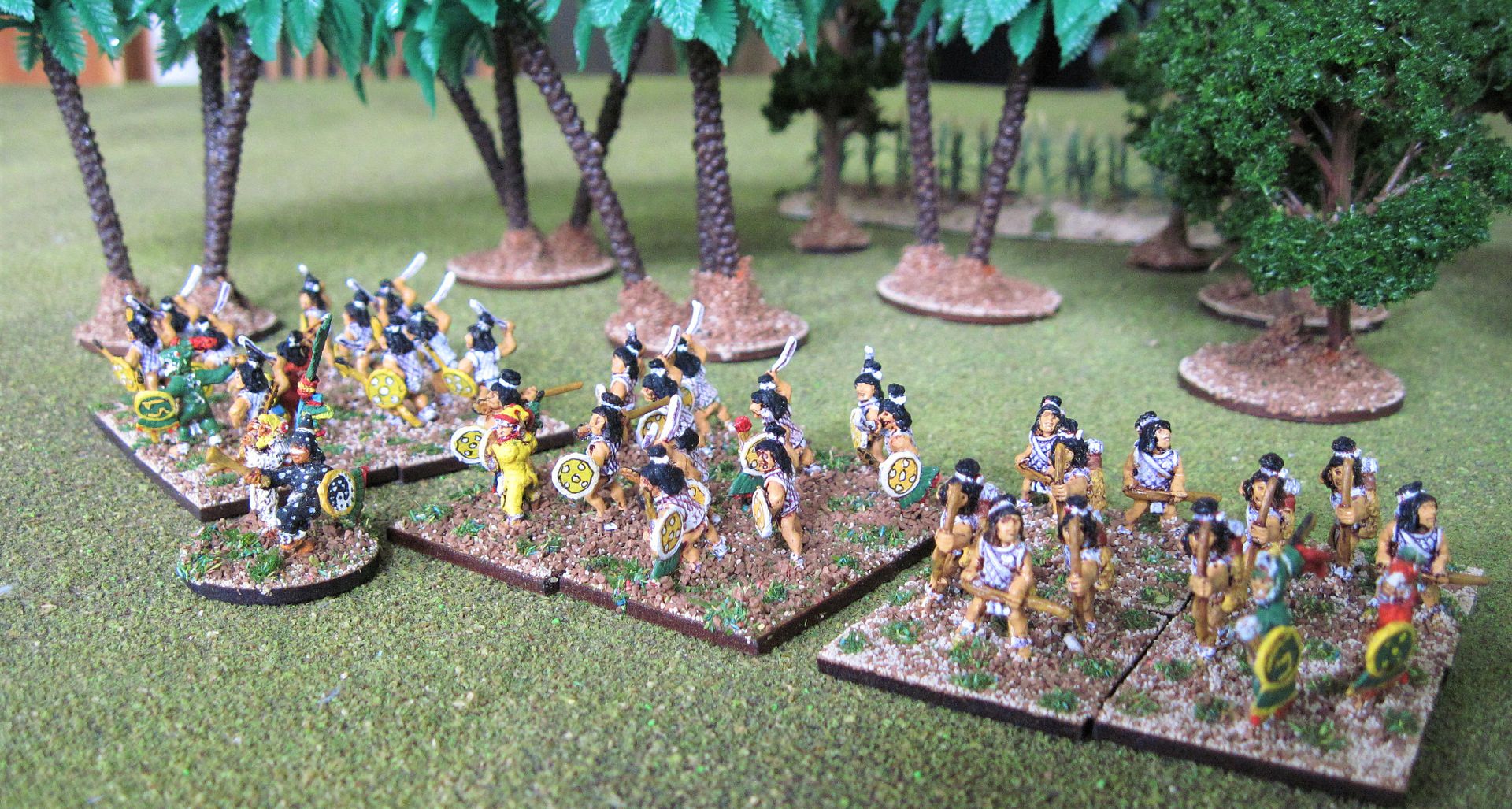
Mexica units were often led by a core of (cotton) armoured veterans with the less skilled or experience warriors behind.  It would be a rare Mexica unit that had no missile capability but for most of them the melee is where they thought to excel.
 I’d rate most Mexica units as mixed with a close range missile ability, the exceptions being at the extremes – Knights and dedicated slingers or archers who have greater range.
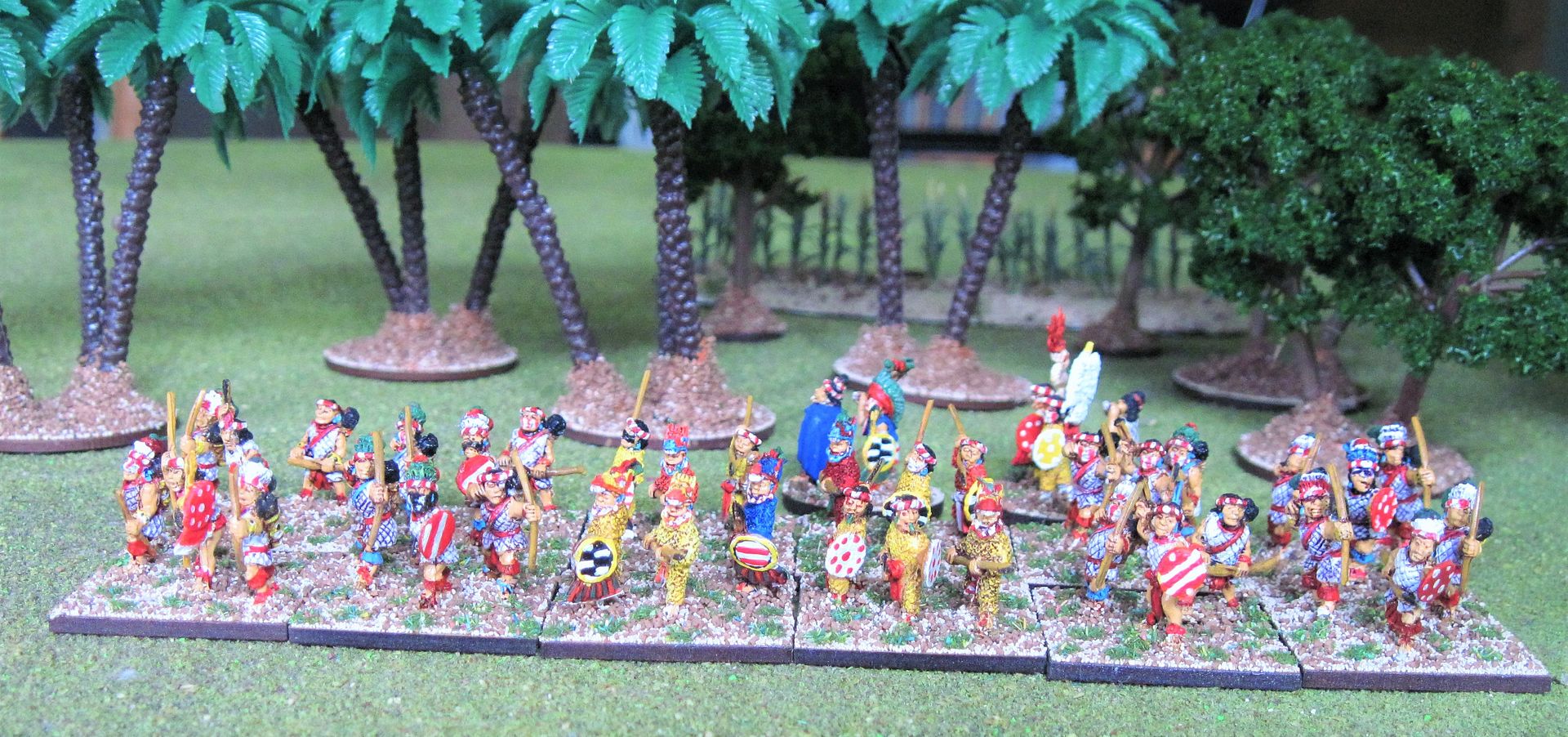
The Tlaxcala archers were always accompanied by agile men with shields and are clearly a mixed formation too.

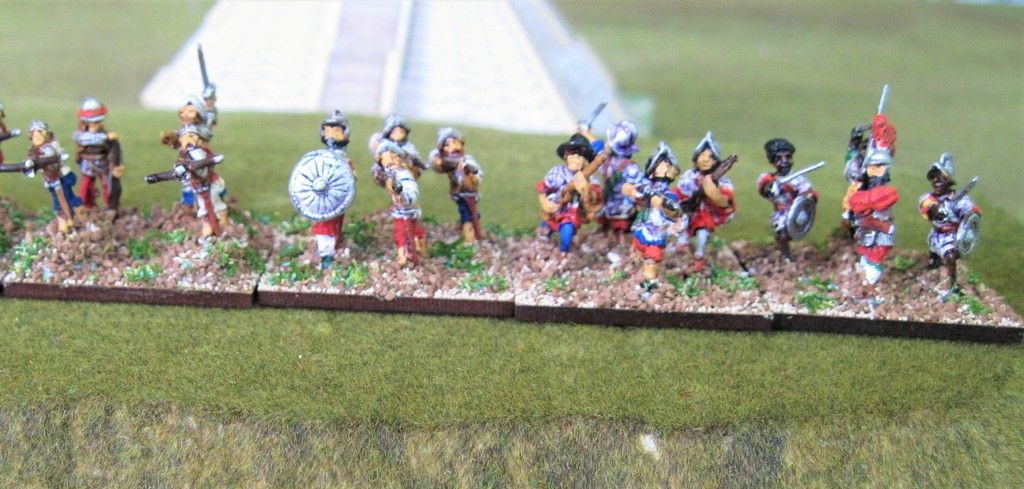
The Spanish out of numerical necessity often used mixed formations but it was also part of their tactical doctrine.

All of the foregoing are different, the Mexica would not manage to equal Tlaxcala fire power with the reverse being so for melee. A unit of Spanish swordsmen would clear the way faster than a mixed Spanish unit would.  All three though are mixed units and rather than create a Gordian knot of factors I’ve simply opted in Have a Heart to rate them Down 1 for both melee and missilery.

Small units, typically two bases for me, were much favoured by the Spanish either to lend an edge of steel to allied formations or because numbers of the ever important cavalry were small and so operated at nothing like European strengths.  In both cases better arms and armour helped make up for lack of numbers but never the less in Have a Heart small units are Down 1 for both melee and missilery.

Big units can be used by all sides as an alternative to the usual four base ones with a Unit Integrity (UI) value of four.  For Have a Heart I suggest big units have either six bases and a corresponding UI or eight bases and ditto UI. The effect of this is simply to make the unit more resilient.


Thursday, 14 July 2016

Have a Heart Post-Game Analysis

So how was it as a reflection of Conquistador Warfare? 


Not bad I think. I’ll now try to set out why I think so.

First the movement system is fine and will not need change it did just what I wanted.

The big news was the loss of commanders on both sides. For the Mexica historically that was a frequent occurrence so let’s examine the death of Pedro. 

Small groups of Spanish cavalry did occasionally become unstuck and their loss was always keenly felt.  In Pedro’s case he led, on the table top, two bases of Spanish cavalry into the rear of 16 bases of Mexica. He destroyed 4 of them outright but the remainder turned and hit him with sling shot and Atl Atl at close range.  He threw a 1 and was eliminated.  Reasonable enough I think. Had the initiative not passed to the Mexica, Pedro may have destroyed the whole command and that too has precedent. So dramatic though it was, and that’s not a bad thing in a game, I’m happy. 


Two other things that need comment are fire power and melee.  Taking them in order the sling's concussive power proved effective against the Spanish as it mostly did during the Conquest.  Mexica slingers however were not elite troops and our two units both took heavy casualties and one of them routed.  The Mexica archers achieved little against the cotton armoured Tlaxcala nobles partially because of poor dice but also because they were not great troops. 

The Tlaxcalla archers were more effective (I rated them specialist) driving off Mexica slingers but they could not hold the line of battle.  Atl Atl were thrown by all the high status warriors on both sides to uniformly poor dice save for unit that helped see off Pedro, a few more games needed perhaps.   Over all the key to effective native firepower is numbers at close range and that I think is right.

The Melees were all characterised by low dice on the Mexica side so collapse for them came more quickly than it might have.  That said I think the troop quality, factors and mechanics of the game seem to work. The role of the Tlaxcala came through very clearly and the Spanish swordsmen were just right.


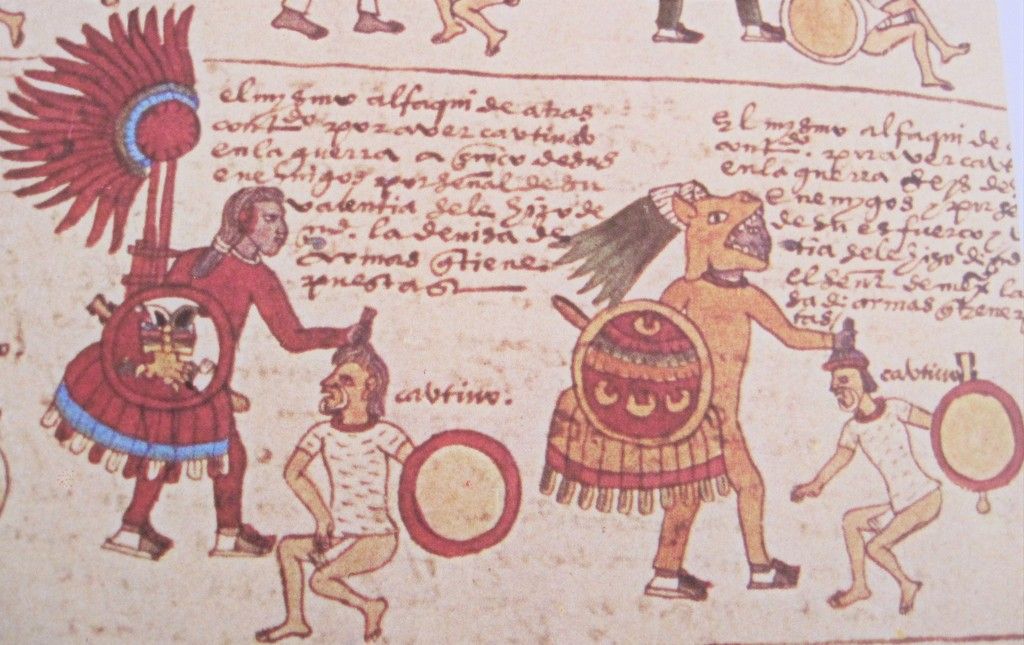
I am now clear on how the Mexica prisoner taking rule will work. In practice the Mexica commander will need to pick the right moment to attempt it and play one of his valuable tactical advantage cards to reinforce the chance of success.  He may lose his advantage in melee if he does so.  But if he pulls it off Mexica morale will soar and the Spanish will start to get shaky.  The idea of dancing a little jig before having one’s heart ripped out and fed to a Demon genuinely frightened them.  


I’ll be testing all that and Spanish firepower in the next test game.  Thank you for reading this and I hope you are finding the development of Have a Heart as interesting as I am.

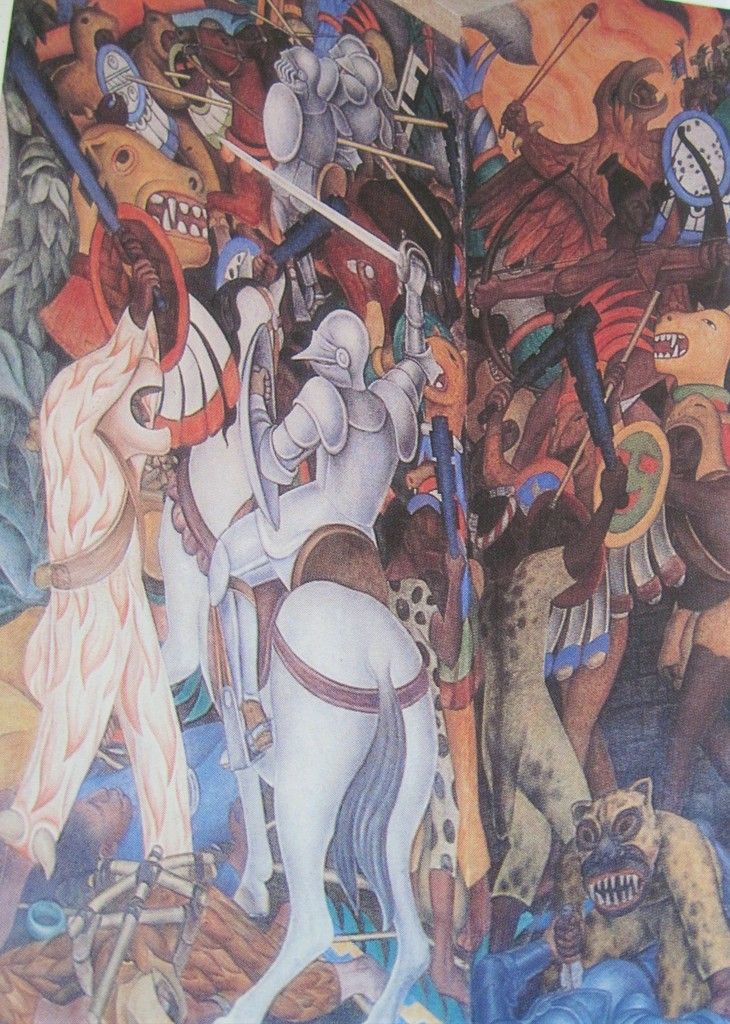
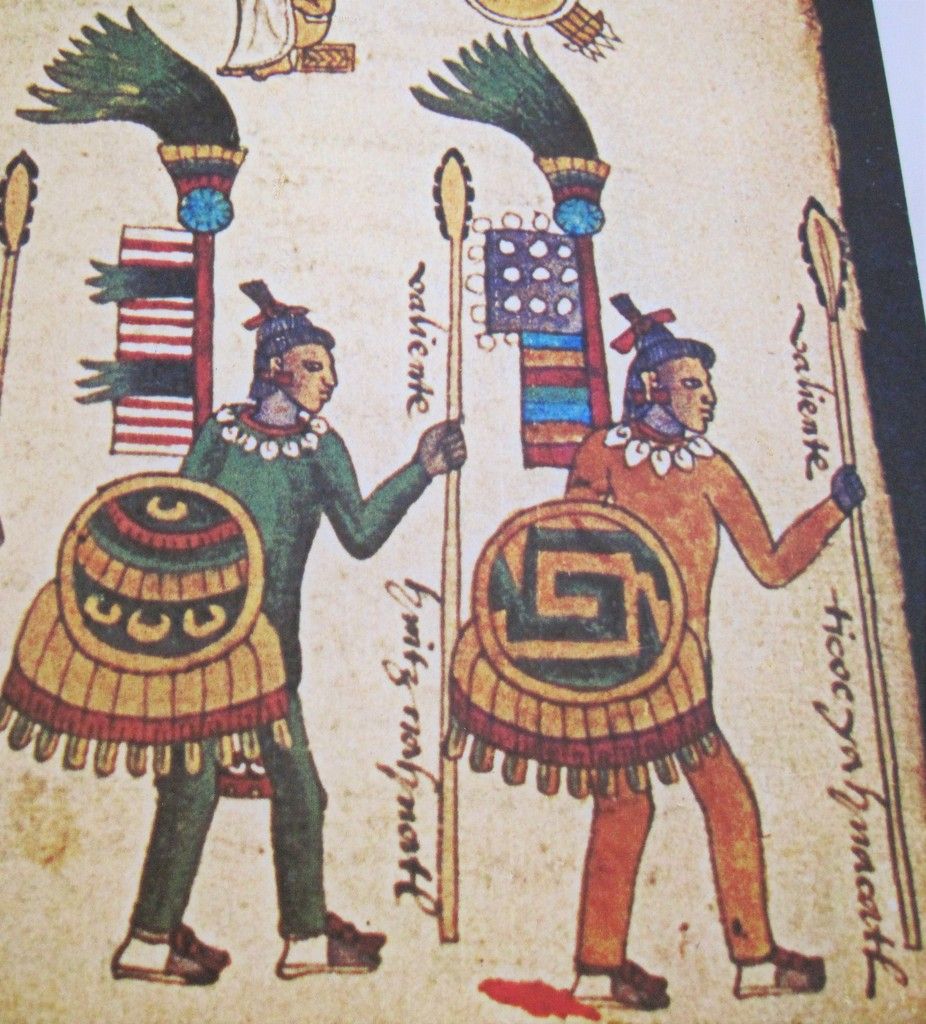
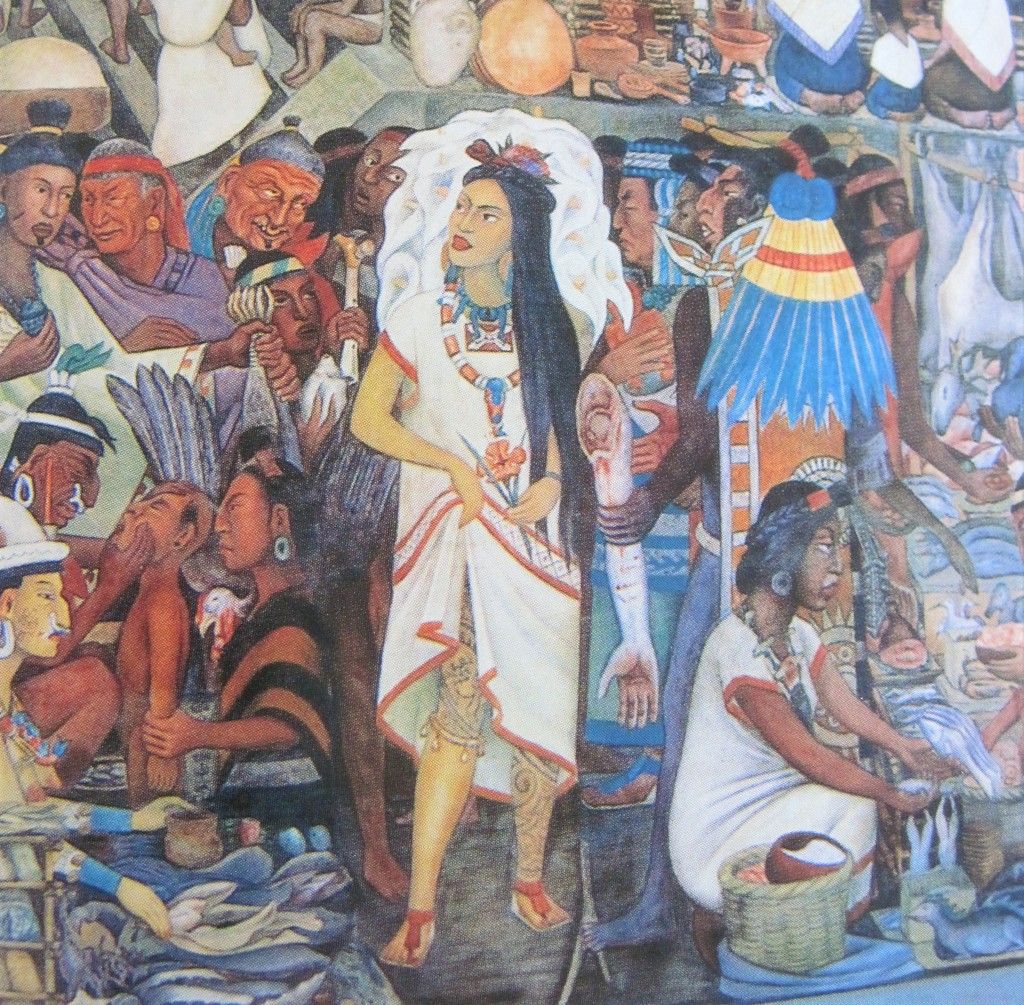
The very fine images in this blog are detail from the paintings of Diego Rivera and illustrations from the Codex Mendoza.
Tuesday, 12 July 2016

A First Play Test – What Happened?

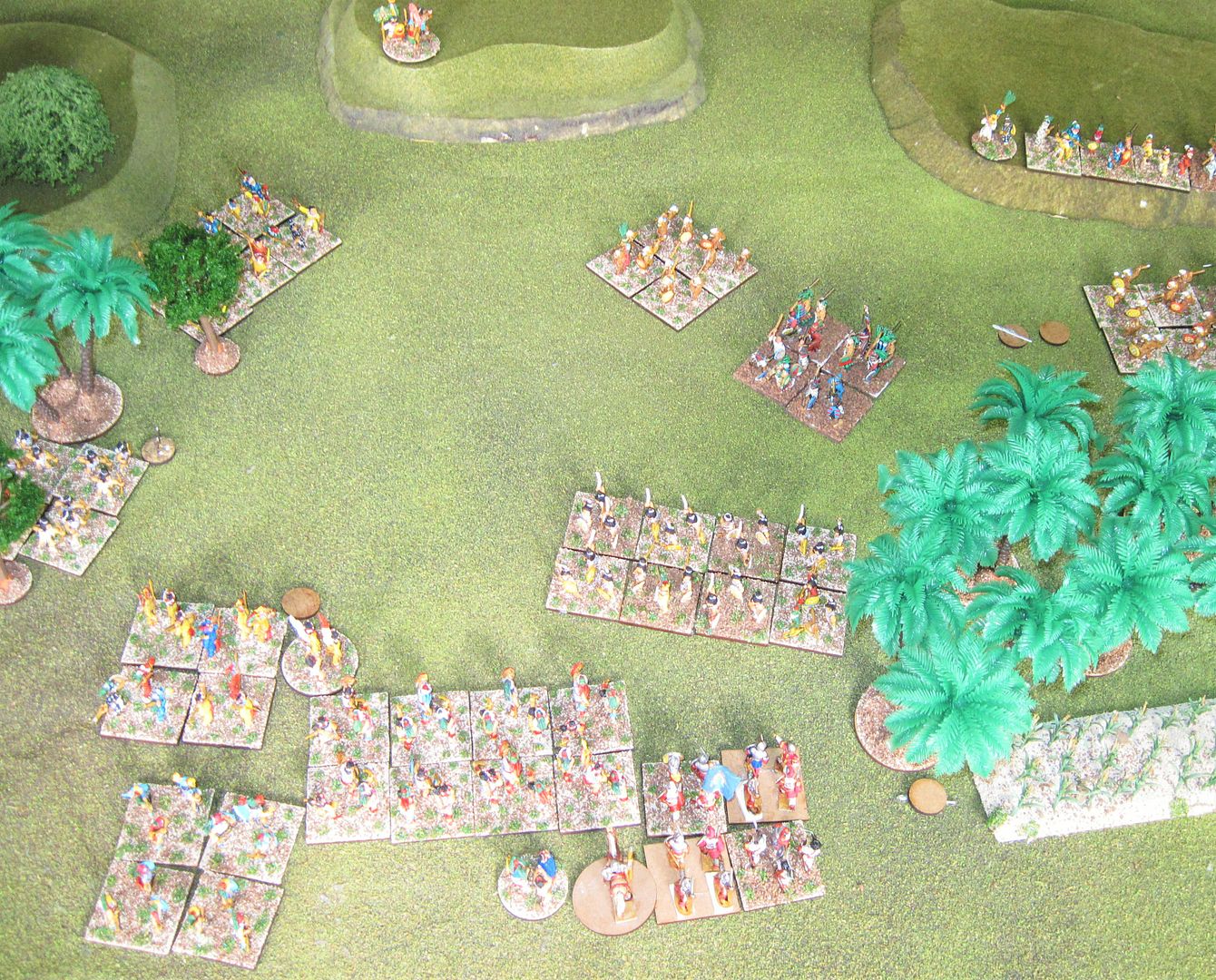
First the ground – The Mexica table edge was all hills and woods leading down to the plain where the Spanish and Tlaxcala forces were formed up.  On a central hill the Mexica commander could be seen surrounded by troops.


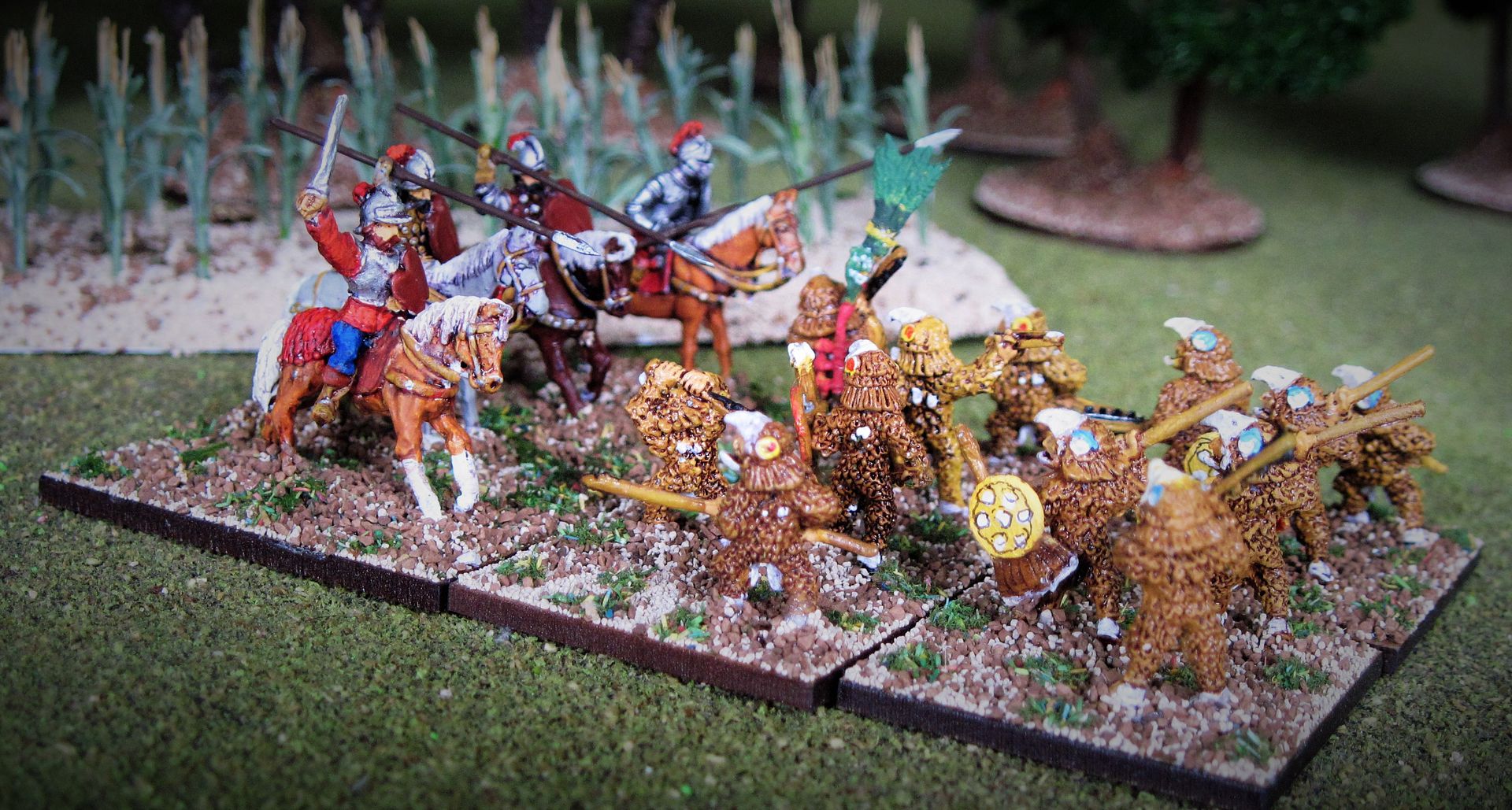
The forces were smallish on both sides. The Spanish had a small unit of cavalry led by the dashing Pedro Alvarado and a unit of swordsmen led by Sandoval. The Tlaxcala, in two commands, fielded two units of archers, a unit of Otomi and one of knights.

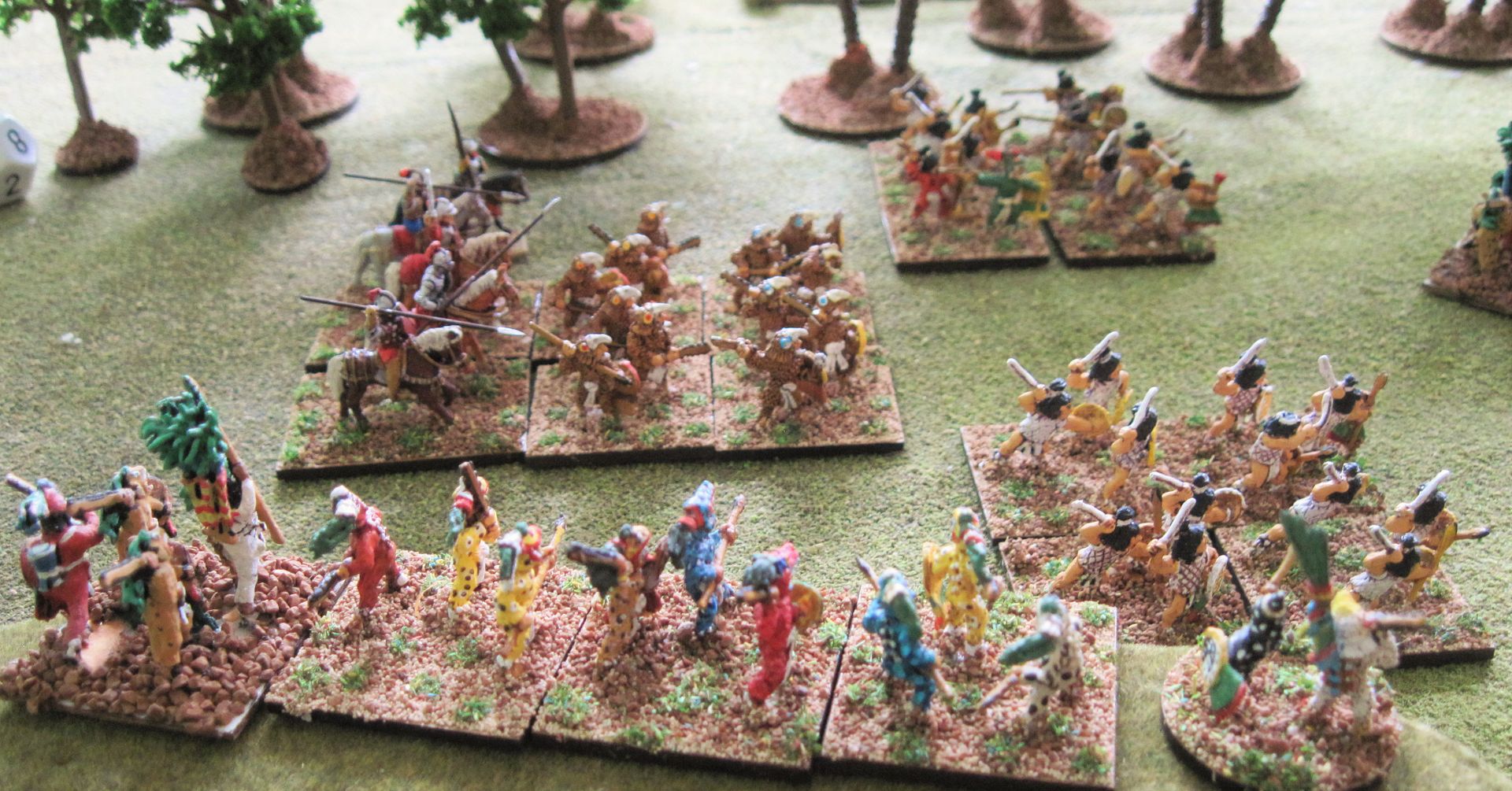
The Mexica had two command groups one comprising of two units of Eagle knights and two of slingers with a unit of warriors. The other had a unit of Cuachics, one of archers and a unit of Jaguar knights.  Most of the second command were concealed.

Plans – The Spanish intended to advance, supported by the Tlaxcala, straight at the Mexica commander while wily Pedro swept around the right flank to hit the Mexica in the flank or even better the rear. The Mexica commander, using himself as the bait, intended a double envelopment and had massed troops on both flanks.

How did it go? In the centre the Spanish and friends made a measured advance (poor movement dice) while arrows stated to fall on the Tlaxcala knights on the flank to little effect.  Meanwhile Pedro and pals had raced (good movement dice) around a wood and found themselves facing the rear of the first Mexica command. They charge into the rear of the Eagle knights, who turn and fight and die and run.  


Pedro has the lads in hand and does not pursue. Now the Mexica react turning (they got a Formation Change Card) to face this terrible threat.  The Spanish horse (two bases strong) are hit with fire from three units (two slingers and one Atl Atl) at close range and throw a 1.  And that's it for Pedro and Co.  As they are out of sight, apart from hearing some rather ominous Mexica whistling, the rest of the allies know nothing of their fate.

Back in the centre Sandoval is continuing his slow advance when the enemy come into view stones start to bounce off Spanish armour and then its like a hail storm (two volleys the second at close range.)  Extremadura's finest stagger back and Sandoval thinks this is when Pedro should attack. Two units of Tlaxcala archers fire on the Mexica slingers driving them off with some loss.


The Mexica were over emboldened by the destruction of the Spanish cavalry and charged across the line:

·       The Cuachics engage the Tlaxcalan knights and are pushed back, following up the Tlaxcala prevail again.
·        Eagles charge and drive back a unit of Tlaxcala archers and follow up pushing them out of the allied battle line.
·        Mexica warriors charge the Spanish and are thrown back with losses.
·       Jaguars hit the Spanish and are held in melee and then routed with heavy losses. In the melee the Mexica commander is slain.


And that was it – the Mexica were out of morale points and they could only withdraw. I'll do some post match analysis and report back but so far so good I think.

Monday, 11 July 2016

The Spanish Advantage

The Spanish Advantage in confronting the Aztec and Inca empires was more than Guns, Germs and Steel* although all of those enabled success.

With a few exceptions the average Conquistador with Cortez was not a veteran of the Italian Wars.  The Great Captain was a name to him not a lived experience, he was not drawn from the ranks of Spain’s ever victorious armies.


Often he was a member of the minor gentry living two steps from poverty and desperate for money and status.  He was habituated to violence, killing and the pursuit of legal disputes.  Lack of status and financial desperation had brought him to the New World in hope of splendid redress.  His world view was shaped by the national experience of the Re Conquista. The concept of the long war and overcoming adversity was engraved on his soul.  He was an uncompromising if erratic Christian and utterly confident in his civilisation.


The first Spanish battles against the Maya came as a shock to the Conquistadores.  Here was an enemy that manoeuvred in formation, that could attack and withdraw at will, that used fire power in a way they recognised.  Ultimately the Spanish cavalry saved the day but never the less valuable lessons were learned.

The Mexica had no lasting answer to the horse or Spanish steel, the former always meant native armies could be located and disrupted.  The latter that, so long as the Spanish formation held, close fighting casualties would be disproportionately high for their opponents.


Gunpowder weapons and crossbows added to the effect; the gorgeously clad native captains, instantly identifiable by their huge feather banners, could be killed at a distance.  Equally a swift advance of horsemen could deliver a lance thrust, a la jinete, to the face leaving the foe leaderless and demoralised by the sudden death of such an able and ferocious captain.


Finally, the Conquistadores had huge numbers of native allies to further tip the balance in their favour.

*Jared Diamond's very interesting book.

Saturday, 9 July 2016

Tlaxcala

Tlaxcala, meaning place of the corn tortilla, sat higher above sea level than the valley of Mexico.  The Tlaxcala like their Mexica opponents were a Nahuatl speaking people and like the Mexica their state comprised of allied cities.

At the coming of the Spanish the Tlaxcala were locked in an ongoing struggle with Mexico that could only end in their subjugation or annihilation. Surrounded by Mexica controlled territory and stripped of allies, a trade embargo was already resulting in shortages of cotton and more importantly salt.


A Flower War had already concluded to Tlaxcalan disadvantage and now martial effort was concentrated on a defensive strategy to repel Mexica incursions.  Having a smaller population than Mexico the Tlaxcala had less warriors in general and specifically less professional soldiers.
  

Their strategy relied on being nearer to resupply of armament and food than the invading Mexica.  If the Mexica could be held they would get hungry and go home. Unlike the Mexica the rank and file of Tlaxcalan army were mainly archers.


Within the Tlaxcalan territory lived a minority population of extremely warlike Otomi who when the Spanish arrived were despatched to see them off.


The ensuing battles were, despite high Indian losses, very close fought and some think that had the Tlaxcala persisted they would have destroyed Cortez and his followers.  That would still have left them,in a weakened state, to face the Mexica .  Instead when a chastened Cortez offered peace and alliance against the Mexica they agreed.  

It is likely that both sides considered themselves to be the senior partner.


Wednesday, 6 July 2016

The Macuahuitl

The macuahuitl was a favoured close fighting weapon of the Mexica warrior.  To be sure they used other weapons too, but in surviving representations the macuahuitl predominates.
The macuahuitl was a flat hard wood baton up to four feet in length its edges were close set with razor sharp flakes of obsidian or flint or in coastal areas Sharks teeth.  Clearly it was a cutting weapon.  Some pictures of the macuahuitl show gaps in the sharp edges, it is conjectured that these maybe less lethal prisoner taking weapons.  It occurs to me that they could just be cheaper weapons.  A sumptuary analysis might confirm that and I may do one later.

To use a macuahuitl to best effect it would be necessary to strike your opponent hard and pull the weapon back or push it forward to bring the length of its edge into contact. Such an action would deepen and lengthen the initial wound.  The resulting damage would be formidable and the blood loss considerable. I’d favour a backward return motion as this would leave the user well balanced for his next strike.  A close reading of Conquistador testimony disproves the wide spread idea the weapon could decapitate a horse.

Just about every Conquistador who ever faced the macuahuitl was wounded, often repeatedly and their accounts of the Conquest make endless mention of wounds and treating the same. Few though were killed by one and we should consider why that was.
The Mexica and their native foes used quilted cotton armour.  It may have been treated like the Greek Linothorax reconstructions to produce a light but resilient armour.  None survives so we cannot know.  It is though suggestive that the Spanish quickly adopted it as a supplement to or for poorer Spaniards a substitute for metal armour.
The Mexica military was meritocratic meaning the best warriors rose fastest in the army and society.  Their military dominated their neighbours by virtue of skill and numbers.  The Mexica were also by any standard very brave and were adaptive in tactics and weaponry.

The macuahuitl could not defeat Spanish armour nor could it equal the Spanish sword which could pierce cotton armour and lop off hands and limbs.  It was an inferior technology in an age of steel and in combat the Conquistador quite simply had more ways of killing than his Mexica opponent.